Your
Ticket To Change
“Acceptance of prevailing standards
often means
we have no standards of our own.”
— Jean Toomer
What Does It Take?
 For most of us,
the ticket to positive change is some amount of pain or dissatisfaction
with the status quo. The degree of pain that precedes taking action
will influence whether we consider that change to be proactive
or reactive — a change initiated by choice or due to necessity. For most of us,
the ticket to positive change is some amount of pain or dissatisfaction
with the status quo. The degree of pain that precedes taking action
will influence whether we consider that change to be proactive
or reactive — a change initiated by choice or due to necessity.
What is the threshold of discomfort that it takes to
motivate you to make a change for the better?
Your Own Traffic Signal
 My friend,
Mike, a healthcare executive with a proclivity toward outspokenness,
commented to me that this trait of his was an asset yet also a
liability that at times found him on the edge of a corporate cliff,
flapping precariously. What helped him adapt his behavior more
advantageously was outlining the signs of what we named “red
flag situations” vs. “yellow flag situations”. My friend,
Mike, a healthcare executive with a proclivity toward outspokenness,
commented to me that this trait of his was an asset yet also a
liability that at times found him on the edge of a corporate cliff,
flapping precariously. What helped him adapt his behavior more
advantageously was outlining the signs of what we named “red
flag situations” vs. “yellow flag situations”.
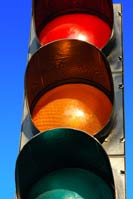
A similar metaphor can be applied as you consider your
personal threshold for change. If a red light signals
an urgent scenario where change is an uncomfortable necessity
and a green light represents a more relaxed and confident kind
of change, then yellow becomes the optimal combination
of discomfort/comfort that can produce great outcomes.
Here are some examples from real people:
- A manager who worked in a paper intensive industry
felt hemmed in and disorganized by the many files in her office:
a rising river that was about to flood. Now her yellow
light goes on when the files are at a much lower water level.
This simple yet significant change of lowering her threshold
for the amount of clutter she tolerates has resulted in a higher
standard of organization and an easier ability to focus.
- Tim had wanted to change careers for years now
and had grown to dislike his job more and more every day. Two
weeks ago he was fired. He is mostly relieved, though, and fortunately,
he paid attention to earlier signs of dissatisfaction and started
a part time job on the side two years ago in order to pursue
his interest with another company. He is now well positioned
to expand his role there.
- When Brenda had an honest conversation with her friend
of 19 years about some hurtful behavior she had previously
accepted, she knew her relationship standard had been raised.
It’s now easier for her to address conflict at the yellow
light level and she’s become a more direct communicator.
- After the scare of John’s heart attack he lost
30 pounds and has learned to slow down the pace of
his life when needed. It no longer takes a red light event for
him to pay attention to his health.
Lower Your Threshold, Raise Your Standard
Lowering your personal threshold of discomfort does not require
you to adopt a hair-trigger reaction time or to dwell on your
discontent. You can be appreciative of all you have in the very
moment of raising your standards.
This Week’s Call to Action:
- Where have you been settling? Specify the threshold of discomfort
to consciously lower. In doing so, what is the standard you
have just raised?
- What action is required to uphold your new standard?
“Any time you sincerely want to
make a change,
the first thing you must do is to raise your standards.”
— Anthony Robbins
Here's to you,

See Also: Is
Pressure Your Paradigm? and It’s
Okay To Want More |